



In an era defined by urban densification, shifting mobility patterns, and creative land reuse, parking garages and surface lots occupy a uniquely complex position in the commercial real estate landscape. Long dismissed as unglamorous infrastructure, these assets are drawing renewed attention from investors, municipal planners, and commercial lenders alike. Whether you are acquiring a standalone surface lot as a development hedge, refinancing an aging structured garage, or repositioning a parking asset as part of a mixed-use vision, understanding the financing environment is essential to executing a profitable strategy.
Why Parking Assets Are Back in the Spotlight
The narrative around parking real estate has shifted considerably since 2022. While early post-pandemic predictions suggested ride-sharing and remote work would decimate parking demand, the reality has proven far more nuanced. According to the National Parking Association's 2024 industry outlook, urban parking utilization rates in major metros rebounded to approximately 78 percent of pre-2020 levels, driven by the return-to-office trend, healthcare facility expansion, and the persistent growth of event-driven venues such as stadiums, concert halls, and convention centers.
Surface lots, in particular, have become prized as "land bank" investments in supply-constrained urban markets. Investors acquire them at relatively low per-square-foot costs, generate interim income through parking operations, and retain optionality for future ground-up development or sale to a developer. This dual-income thesis, combining near-term cash flow with long-term land appreciation, has made surface lots a surprisingly competitive asset class in cities like Nashville, Austin, Denver, and Charlotte, where infill land is increasingly scarce.
"In 2024, urban surface lot transactions in the top 20 U.S. markets averaged a 6.1% capitalization rate, outperforming many stabilized retail strip centers and reflecting growing investor confidence in the asset class." - National Parking Association, 2024 Industry Report

How Commercial Lenders Evaluate Parking Properties
Financing a parking garage or surface lot comes with a distinct set of underwriting considerations that differ meaningfully from office, retail, or multifamily assets. Lenders tend to view these properties through the lens of income stability, operational risk, and long-term land utility. Borrowers who come to the table with a clear understanding of how underwriters think about these factors are far better positioned to secure favorable terms.
Key factors that lenders examine include:
- Net Operating Income (NOI) Stability: Lenders look at 12 to 24 months of operating history. Seasonal fluctuations, event-driven revenue spikes, and lease versus transient revenue splits all factor into how reliably income can be projected forward.
- Lease Structure: Properties with long-term ground leases or management contracts with institutional operators, such as SP Plus or Ace Parking, are viewed more favorably than purely transient-revenue operations.
- Market Demand Drivers: Proximity to hospitals, universities, sports venues, transit hubs, or dense office corridors significantly strengthens the credit case for a parking asset.
- Land Value and Redevelopment Potential: Lenders increasingly factor in the underlying land value as a secondary repayment source, particularly for surface lots in high-growth urban zones.
- Environmental Considerations: Phase I and sometimes Phase II environmental assessments are standard requirements, as surface lots may carry legacy contamination from prior uses.
- Operator Experience: Sponsoring borrowers with a track record in parking operations or commercial real estate management receive more favorable scrutiny during the credit approval process.
Loan-to-value ratios for parking assets typically range from 60 to 70 percent through conventional bank lenders and CMBS channels, though bridge lenders may go higher in markets with demonstrably strong fundamentals. Debt service coverage ratios of 1.25x or better are standard minimums, and many lenders impose seasoning requirements before refinancing newly acquired assets.
Loan Structures and Capital Sources for Parking Assets
The capital markets for parking properties are more varied than many borrowers initially expect. Depending on the asset type, stabilization status, and borrower business plan, several financing structures may apply.
For stabilized structured parking garages with consistent NOI, conventional bank loans and CMBS conduit financing represent the most cost-effective options. CMBS, in particular, has shown resilience as a channel for parking assets: several notable garage portfolios were securitized in 2023 and 2024, including portfolios tied to urban medical campuses and airport-adjacent facilities. These deals benefited from long-term lease income from institutional tenants, which aligned well with the fixed-rate, non-recourse structure that CMBS provides.
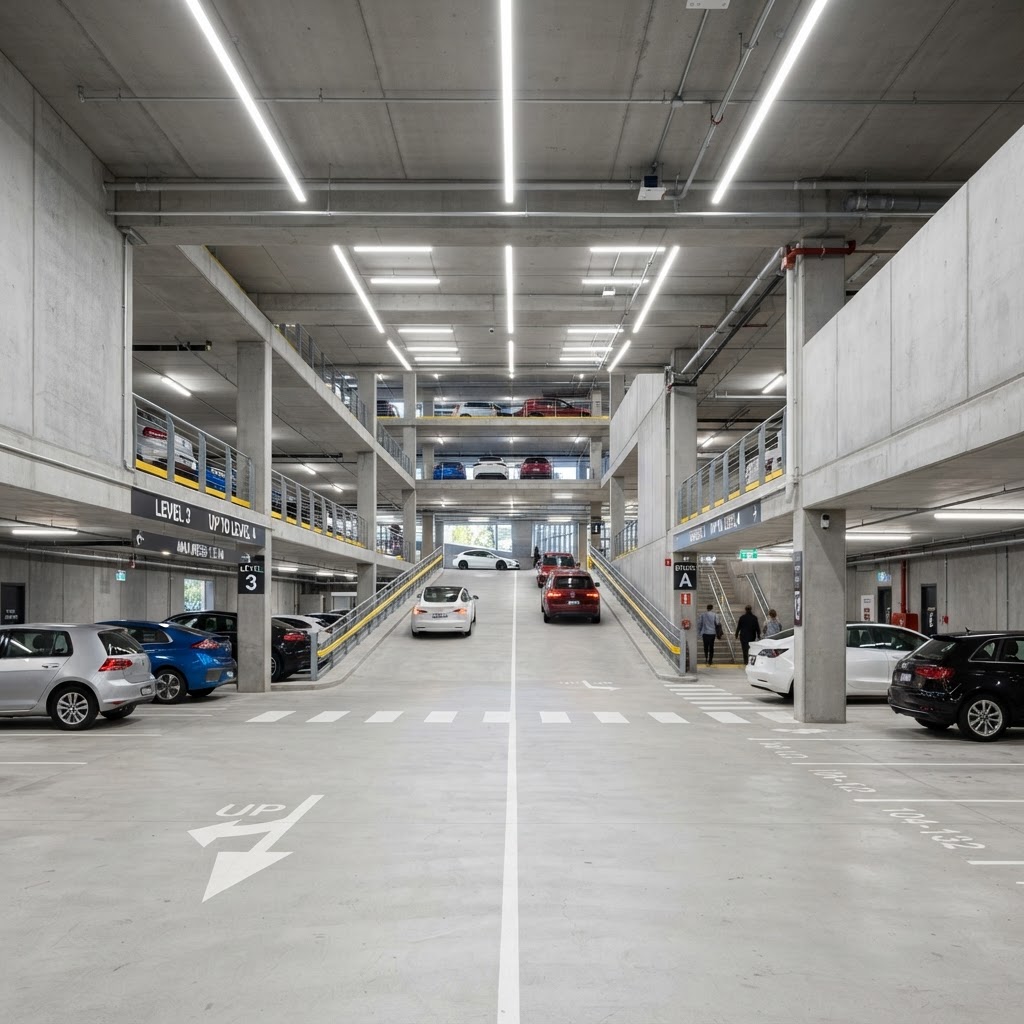
For transitional or value-add scenarios, including surface lots being repositioned for development or garages undergoing renovation, bridge loans are the preferred vehicle. Bridge lenders typically offer 18 to 36-month terms with interest-only payment structures, giving investors the runway to execute their business plan before transitioning to permanent financing. SBA 504 loans can also serve owner-occupied parking operators, such as hospitals or universities that own and operate their own garage infrastructure, with favorable long-term fixed rates on the subordinate debenture portion.
Life insurance companies represent another compelling source, particularly for trophy structured garages in gateway markets. These lenders tend to favor conservative loan structures, strong sponsorship, and assets with dominant market positions, but they offer competitive long-term fixed rates that can be transformative for a borrower's hold-period economics.
Urban Infill Strategy: Parking as a Bridge Asset
One of the most sophisticated strategies emerging in urban commercial real estate is the deliberate acquisition of parking assets as infill development bridges. Rather than competing for finished multifamily or mixed-use sites at compressed cap rates, forward-thinking developers acquire surface lots with existing parking operations, allowing the asset to generate cash flow while entitlements, capital stacks, and construction timelines are assembled. This approach is particularly prevalent in Opportunity Zone-designated areas, where tax incentive structures reward patient capital and phased development.
Cities such as Atlanta, Phoenix, and Minneapolis have seen a notable uptick in this strategy since 2023, as zoning reforms in many municipalities have relaxed minimum parking requirements, effectively unlocking surface lots from their historical highest-and-best-use constraints. When a city eliminates or reduces mandatory parking minimums, as Minneapolis did comprehensively in 2023 through its 2040 Plan implementation, surface lot owners gain new flexibility to redevelop without replacing parking on a one-for-one basis, dramatically improving the economics of ground-up projects.
Lenders evaluating these bridge scenarios focus heavily on exit strategy clarity. A borrower who can demonstrate a credible path to either a development takeout, a sale to a residential developer, or a long-term refinance onto a stabilized asset is far more likely to secure financing at competitive terms. Proforma underwriting supported by market comparables, zoning confirmation letters, and pre-leasing or pre-sale agreements will strengthen any financing package considerably.
Looking ahead, the intersection of autonomous vehicle technology, electric vehicle charging infrastructure, and evolving urban land use policy will continue to reshape how parking assets are valued and financed. Savvy investors who position parking properties with adaptive reuse flexibility, whether through flexible structural design in garages or unencumbered land in surface lots, are likely to benefit as lenders grow more sophisticated in underwriting these transitional assets. The commercial mortgage market for parking is not shrinking; it is evolving, and those who understand its nuances will find meaningful opportunity in the years ahead.


